
Our brains like to follow rhythm, which is why sound and music can play important roles in our physical and mental health. You may have heard about binaural beats, the so-called “digital drugs,” that have featured across social media and podcasts, and which have gained popularity as a way to influence mood, relaxation, focus and cognitive functioning. But what does the science actually tell us?
What are binaural beats?
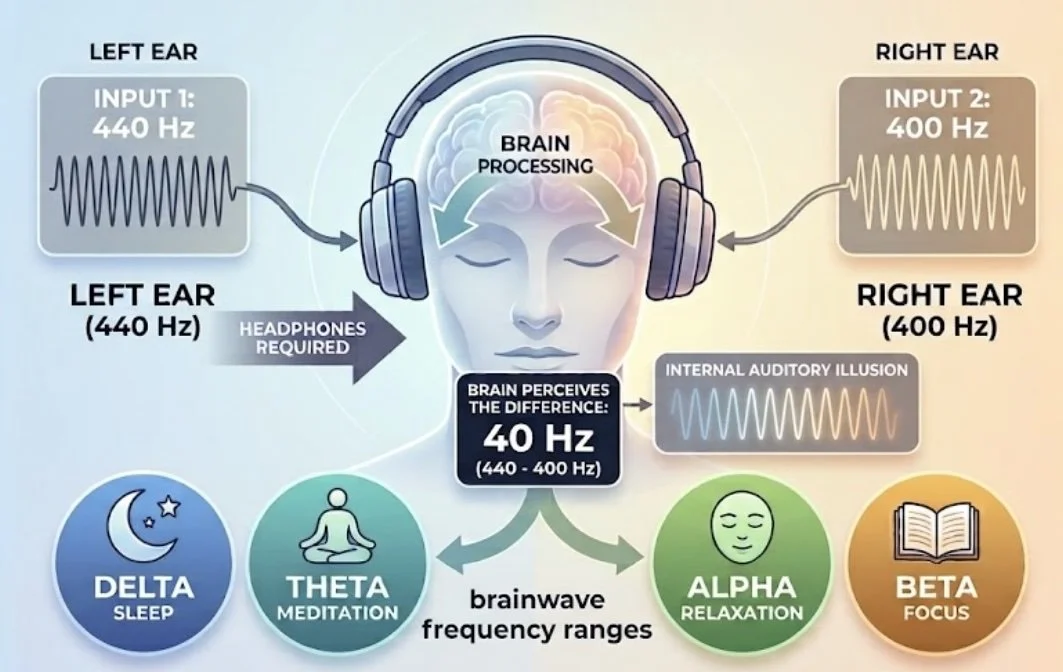
Binaural beats are an auditory illusion that occurs when sounds of slightly different frequencies are transmitted simultaneously to each ear. For example, if a 440 Hz tone is transmitted to one ear and a 400 Hz tone to the other, parts of the brain work together to create the perception of a third frequency equal to the difference between the two (40 Hz). This psychoacoustic phenomenon, the binaural beat, is reported to influence mental states, emotions and cognition, and was first described in 1839 by H. W. Dove¹.
A growing body of evidence investigating the effects of binaural beats suggests they have the potential to change brain activity in specific frequency bands and, therefore, have a psychological influence. We examine the evidence relative to the five bands of brainwave frequencies; delta, theta, alpha, beta, and gamma.
Delta (0.5–4 Hz). Delta brainwaves are the slowest oscillations. They are prominent when we are in restful sleep and are associated with a state where our mind and body are at their most restful and calm. Our bodies tend to heal and regenerate during these times. Some studies indicate that binaural beats within this frequency band may have anti-anxiety effects and lower stress², however, it is important to note that the evidence does not support binaural beats directly inducing deep sleep states.
Theta (4–8 Hz). This frequency range has mostly been investigated for its influence on relaxation and calmness. Theta waves facilitate rapid eye movement (REM) sleep and are associated with emotional regulation. Studies have found that theta binaural beats may influence a reduction in pain perception, lower short-term anxiety, and enhance cognition³.
Alpha (8–13 Hz). Alpha frequencies are associated with a calm, yet still alert, state. Within this brainwave state, light reading, creativity, and focus can occur. Studies of alpha binaural beats show preliminary evidence for stress reduction⁴ and enhanced creativity via influencing the release of dopamine⁵.
Beta (13–30 Hz). Brainwaves within this frequency band are active when we need to think, concentrate, and solve problems. There are inconsistent results regarding the effects of beta binaural beats on cognition overall⁶, but some studies have found positive influences on focused work and study⁷.
Gamma (30–70 Hz). Brainwaves within this frequency range promote wakefulness and alertness. Some research shows gamma binaural beats can influence attentional control²; however, studies are limited in this area.
What does this all mean?
Our knowledge base and understanding of binaural beats are still emerging. Claims that binaural beats can enhance memory and supplement treatment of some psychiatric conditions such as depression is limited and has yielded inconsistent results—mainly due to the heterogeneity of the studies—that is, variety or diversity exists among the studies, making comparisons and generalisations difficult.⁸ ⁹ There are, however, promising preliminary findings that binaural beats within some frequency bands may help reduce anxiety and stress, promote analgestic effects within the body and support focus.
It is important to note that existing evidence supports binaural beats as an adjunct to existing interventions or strategies, and as a cost-effective, safe, and accessible way to encourage your brain to stay alert or induce a more relaxed, regulated state.
Try them out—you only need a sound source (search your usual music streaming service), a set of headphones, and an open mind to experience something new!
Endnotes
da Silva Junior, M., de Freitas, R. C., dos Santos, W. P., da Silva, W. W. A., Rodrigues, M. C. A., & Conde, E. F. Q. (2019). Exploratory study of the effect of binaural beat stimulation on the EEG activity pattern in resting state using artificial neural networks. Cognitive Systems Research, 54, 1–20. https://doi.org/10.1016/j.cogsys.2018.11.002
Garcia-Argibay, M., Santed, M. A., & Reales, J. M. (2019). Efficacy of binaural auditory beats in cognition, anxiety, and pain perception: a meta-analysis. Psychological Research, 83(2), 357–372. https://doi.org/10.1007/s00426-018-1066-8
Fatima, I., Zaidi, S., Sundus, H., Alam, M. F., Parveen, H., & Khan, S. A. (2026). Efficacy of theta binaural beat therapy on pain, cognition and anxiety in adults: A systematic review and meta-analysis of randomized controlled trials. Explore (New York, N.Y.), 22(5), 103471. https://doi.org/10.1016/j.explore.2026.103471
Chen, B., Wong, C., Dzebley, R., & Stone, J. M. (2025). Effect of Binaural Beats on Affective Symptoms and Performance on the Digit Span Test. Cureus, 17(10), e94182. https://doi.org/10.7759/cureus.94182
Reedijk, S. A., Bolders, A., & Hommel, B. (2013). The impact of binaural beats on creativity. Frontiers in Human Neuroscience, 7, 786. https://doi.org/10.3389/fnhum.2013.00786
Ingendoh, R. M., Posny, E. S., & Heine, A. (2023). Binaural beats to entrain the brain? A systematic review of the effects of binaural beat stimulation on brain oscillatory activity, and the implications for psychological research and intervention. PLOS ONE, 18(5), e0286023. https://doi.org/10.1371/journal.pone.0286023
Colzato, L. S., Barone, H., Sellaro, R., & Hommel, B. (2017). More attentional focusing through binaural beats: evidence from the global-local task. Psychological Research, 81(1), 271–277. https://doi.org/10.1007/s00426-015-0727-0
Askarpour, H., Mirzaee, F., Habibi, F., & Pourfridoni, M. (2024). Binaural beats’ effect on brain activity and psychiatric disorders: A literature review. The Open Public Health Journal, 17, e18749445332258. https://doi.org/10.2174/0118749445332258241008103504
Baseanu, I. C. C., Roman, N. A., Minzatanu, D., Manaila, A., Tuchel, V. I., Basalic, E. B., & Miclaus, R. S. (2024). The Efficiency of Binaural Beats on Anxiety and Depression—A Systematic Review. Applied Sciences, 14(13), 5675. https://doi.org/10.3390/app14135675