
Our brains tend to favour the path of least resistance. The law of least mental effort suggests that our brains will try to limit mental effort during a task by avoiding decisions that require more demanding cognitive resources. If presented with options to reach a goal, the natural choice will be the option that requires the least amount of thinking and mental energy. In other words, our brains will try to get out of doing something hard if they can!¹
However, appropriately challenging experiences can create opportunities for learning, whether in the classroom, the workplace, relationships, or when we want to understand more about ourselves and our behaviour. A challenging experience stretches our existing knowledge and skill base, encourages us to try a new strategy or exert effort to find a solution or resolve a problem. Mistakes and errors are therefore extremely valuable in this process – they can reveal a mismatch between expectation and outcome, helping us identify what needs updating and what further information we may need in a particular circumstance. When we reflect, correct mistakes and try again, learning continues, and outcomes can improve. With repeated practice, the brain can modify existing neural connections and networks, and sometimes form new connections. These networks are shaped by past experiences, learning, expectations and emotional associations. Neuroplasticity allows these patterns to be modified, supporting the acquisition of new skills and changes in thinking and behaviour.⁴
Learning can also occur when outcomes are expected, through repetition, practice and consolidation. However, in the absence of new information or a different response, we can reinforce existing habits of thinking and behaviour through repetition, allowing familiar cycles and patterns to persist.
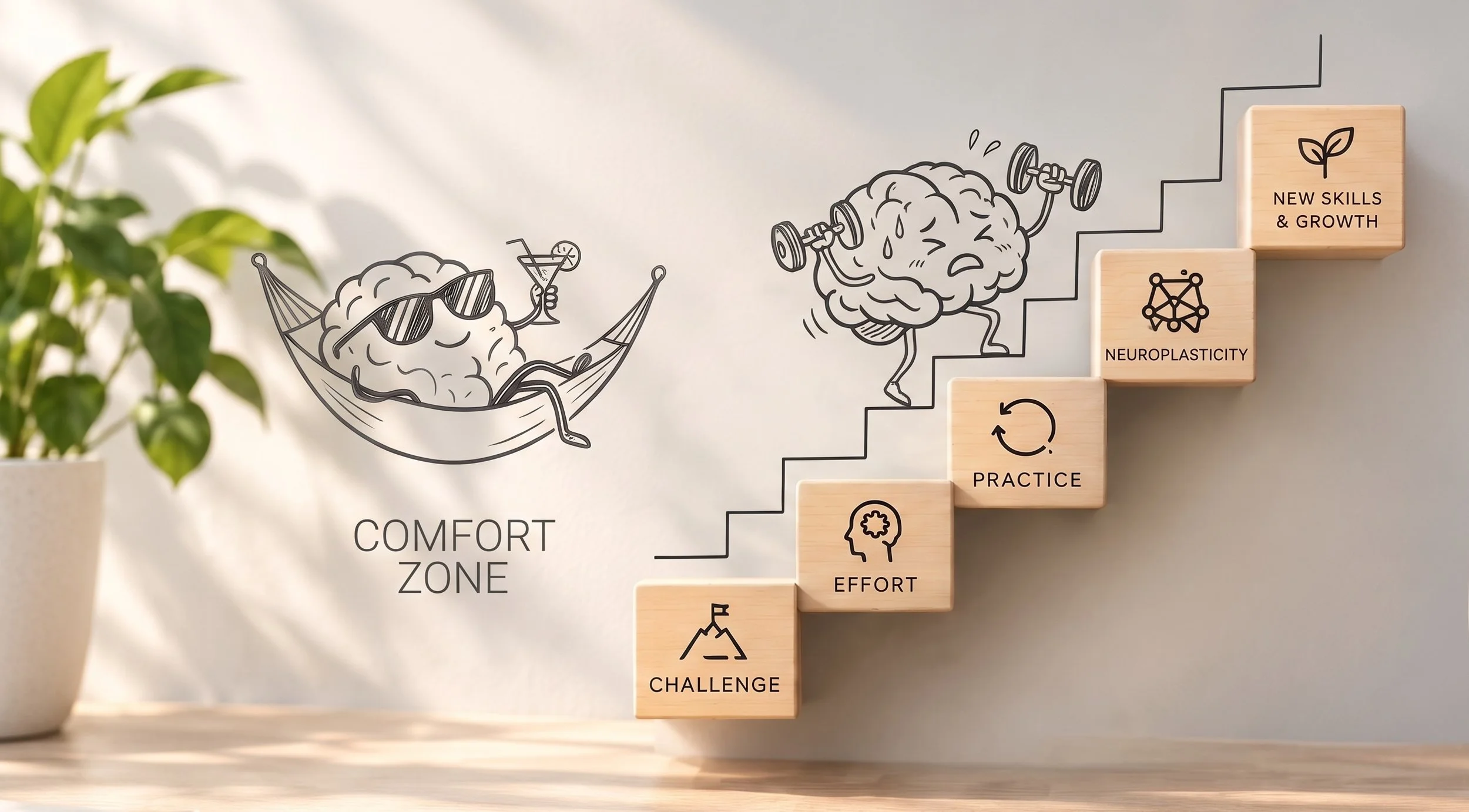
Your brain is built to adapt.
Every attempt is an opportunity for your brain to rewire, strengthen connections and build new ways forward.
Research suggests that cognitively demanding tasks can be associated with improved learning outcomes and motivation. However, cognitive demands are not the same as workload; higher workload can have the opposite effect on learning and is associated with increased strain.² The learning process can also benefit from persistence and frustration, provided the discomfort remains manageable. We have all heard the “no pain, no gain” mantra, and to some extent, this holds true. However, manageable discomfort is distinct from distress and overwhelm. Appropriately challenging experiences, including making mistakes and persisting through difficulties, can support the learning process.³ What constitutes a manageable level of discomfort will vary from person to person, but effective learning conditions tend to involve the right level of difficulty that supports learning and can be applied in other contexts, and involve (albeit subjectively) the perception that the task is effortful.³
In a world that is increasingly technology-driven, we may need to consciously choose an effortful and manageably discomforting path, especially when the benefits or outcomes are not immediately apparent. High effort, difficulty, persistence and sometimes frustration are not comfortable, and yet learning and therefore change, can rely on these very ingredients.
Thanks to neuroplasticity, your brain is amazingly capable of change and adaptation. Next time you are tempted to use AI to solve a problem or summarise material to avoid reading it yourself, consider what opportunities to learn and strengthen cognitive “muscle” you might be missing out on—and how engaging your brain could help you unlock its full potential.
Note: This article, like all our blog articles, was not written by AI and yes, felt effortful 😉
Endnotes
1. Patzelt, E. H., Kool, W., Millner, A. J., & Gershman, S. J. (2019). The transdiagnostic structure of mental effort avoidance. Scientific Reports, 9, Article 1689. https://doi.org/10.1038/s41598-018-37802-1
2. Kubicek, B., Uhlig, L., Hülsheger, U. R., Korunka, C., & Prem, R. (2023). Are all challenge stressors beneficial for learning? A meta-analytical assessment of differential effects of workload and cognitive demands. Work & Stress, 37(3), 269–298. https://doi.org/10.1080/02678373.2022.2142986
3. de Bruin, A. B. H., Biwer, F., Hui, L. T., Onan, E., David, L., et al. (2023). Worth the effort: The start and stick to desirable difficulties (S2D2) framework. Educational Psychology Review, 35, Article 41. https://doi.org/10.1007/s10648-023-09766-w
4. Galván, A. (2010). Neural plasticity of development and learning. Human Brain Mapping, 31(6), 879–890. https://doi.org/10.1002/hbm.21029